
Forward outlook | As of October 27, 2026, New York | Calendar through December 18, with 2027 planning context
International aircraft finance faces a concentrated run of rate decisions, economic releases and political events before year-end. The important question is how those developments change the cost of funded and hedged debt, airlines’ ability to pay, the timing of aircraft deliveries and the ability to move assets across borders.
Our base case: financing remains selective, with continued pressure on all-in funding costs unless inflation and energy risks ease. Stronger borrowers with reliable cash flows and marketable aircraft should have more financing options than operators facing weak liquidity, currency mismatches or uncertain delivery dates. This is an analytical judgement, not a prediction of individual central-bank votes or a quoted lending market.
The dated calendar: the first decisions arrive within days
The Federal Reserve’s meeting ends October 28, the same date as the UK Budget. The ECB’s monetary-policy meeting ends October 29, and the Bank of Japan meets October 29–30. BEA’s calendar places both the US third-quarter advance GDP estimate and September personal income and outlays, including PCE inflation, on October 29. The Fed therefore decides before those releases arrive; the next day’s data can still reprice the path beyond that meeting.
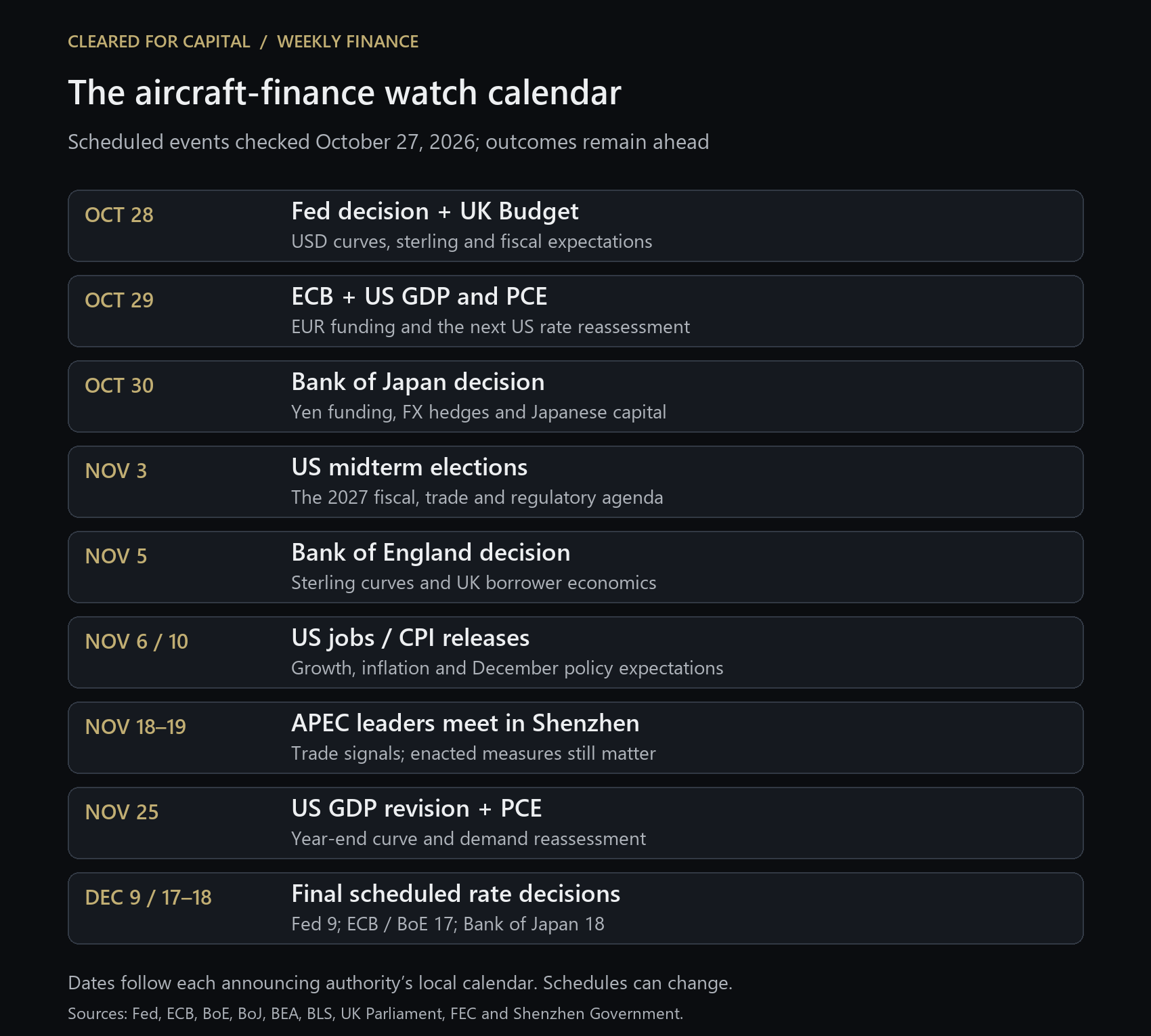
Next come the US congressional general election on November 3, the Bank of England decision on November 5, and US employment and CPI releases on November 6 and 10. APEC’s Economic Leaders’ Meeting is scheduled for November 18–19 in Shenzhen. BEA lists the next GDP estimate and October income-and-outlays release for November 25.
The final scheduled policy round clusters around year-end funding decisions: the Fed on December 8–9, the ECB and Bank of England decisions on December 17, and the Bank of Japan meeting on December 17–18. These are scheduled events, not assumed outcomes. Dates follow the relevant authority’s local calendar; release schedules can change.
1. Rates: a lower headline rate is not the same as cheaper aircraft debt
The starting point matters. The Fed raised its target range to 3.75%–4.00% in September. The ECB deposit-facility rate is 2.50%, while the Bank of England’s published current Bank Rate is 3.75%. These policy rates are not directly comparable quotes for an aircraft financing in dollars, euros or sterling.
Banka Slovenije’s October review, using data available by October 20, described market pricing for a further quarter-point increase by both the Fed and ECB before year-end. That is a dated snapshot, not live meeting odds. Its emphasis on persistent energy-related inflation explains why assuming imminent, broad financing relief would be premature.
Likely effect: policy surprises should feed into benchmark curves, swaps and currencies first. Floating-rate facilities depend on their contractual reset benchmark and any floors; fixed-rate notes and loans depend on the relevant term curve and spread at pricing or hedging. A cut in an overnight policy rate need not produce an equal fall in five-year aircraft debt costs, and existing fixed-rate debt does not automatically reprice.
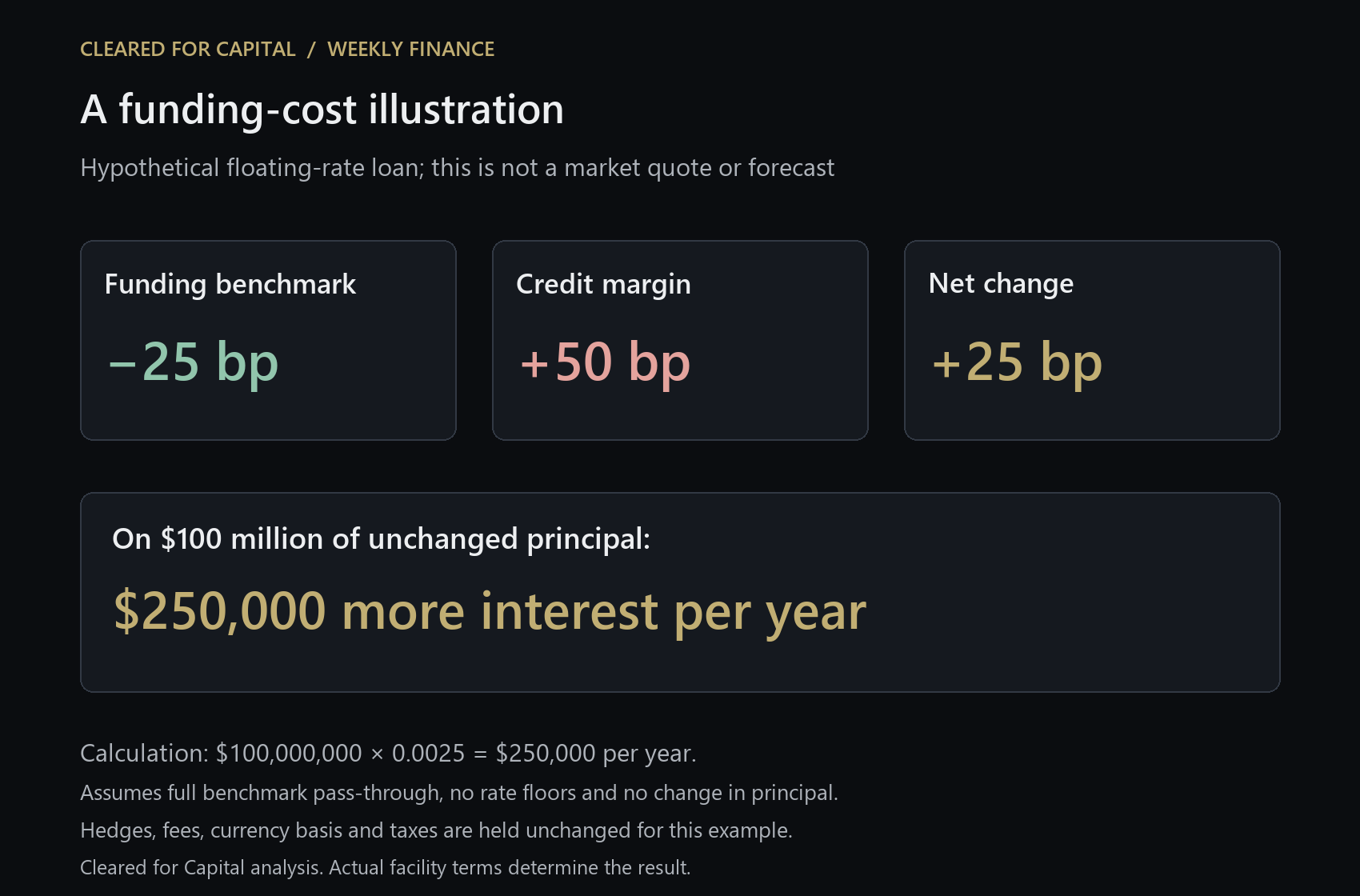
The example holds hedges, fees, currency basis, taxes and principal constant. In a real deal, those items can alter the outcome. The useful comparison is an all-in financing proposal for the same asset, currency, tenor, amortization and risk allocation—not two central-bank policy rates.
For Japanese and European capital providers, the comparison also includes hedging into the lease currency. The Bank of Japan decision can affect yen funding and investor returns without mechanically moving dollar lease costs in the same direction. Cross-currency basis—the difference between direct currency funding and funding through a currency swap—can change that comparison. The BIS definition explains the distinction; its 2026 foreign-currency funding report also highlights the rollover risk that hedges can introduce.
2. Economic releases: growth and inflation can pull credit in different directions
The October 29 GDP and PCE reports, November 6 jobs report and November 10 CPI report will help shape the next round of rate expectations. They also speak to passenger demand, corporate travel budgets, cargo activity and airline margins. A strong growth print can support traffic while sustaining higher interest rates. Softer inflation can help funding conditions; weaker demand can simultaneously make lenders more cautious.
Our interpretation: the friendliest combination for aircraft finance is easing inflation with resilient cash flows. A slowdown that cuts policy rates but weakens lessee credit may widen margins, reduce advance rates or strengthen reserve requirements. That distinction matters for aircraft ABS, bank loans and private credit alike. Our AASET/WAVE analysis explains how benchmark-rate changes and credit deterioration reach lease-backed bonds through different channels.
Currency exposure adds another layer outside the dollar area. If the local-currency cost of a dollar rises 10%, an unchanged dollar lease payment costs 10% more in local currency before hedges, assuming local revenue is unchanged. The vulnerability is the currency mismatch—not an operator’s nationality alone. Airlines and business-jet operators earning mostly local currency need different stress cases from borrowers with matching dollar income.
3. Financing and deliveries: watch the results, then the cash commitments
AerCap will report third-quarter results on October 28, with its call scheduled for 8:30 a.m. Eastern. Airbus also schedules its nine-month results for October 28. For financiers, the useful signals will be lease economics, customer performance, asset-sale outcomes, funding costs, production guidance and delivery timing. The announcements themselves are forthcoming; this article does not assume their results.
Delivery delays can extend pre-delivery-payment borrowing, leave takeout debt undrawn and create additional carry or commitment costs, depending on the contracts. Scarcity may support rentals for aircraft already available, while the owner of an undelivered aircraft still waits for rent to begin. A higher appraised value does not eliminate that timing gap.
For the year-end funding window, the practical issue is whether a commitment, hedge and draw period still match the likely delivery or refinancing date. Banks, leasing companies, ABS investors and private-credit providers do not all have the same capacity or pricing constraints. We expect execution certainty and the terms of committed funding to remain important, particularly around the December decision cluster.
Two disclosed milestones also bear watching: Southwest expects its notes to settle on November 2, while JetBlue expects additional aircraft-backed funding in the fourth quarter. They are issuer-specific tests of execution, not proof that financing is equally available worldwide. Their announced status and source documents appear in our weekly deals briefing.
4. Politics: the UK Budget, US election and APEC have different channels
UK Budget, October 28: the main financing channels are fiscal expectations, gilt yields, sterling and any actual tax measures affecting aviation demand, aircraft ownership or leasing. Watch the published measures and effective dates before changing a transaction model. A fiscal announcement can move funding markets before a tax change affects operating cash flows.
US election, November 3: the outcome can change expectations for the 2027 fiscal, trade and regulatory agenda. Its effect on aircraft finance depends on subsequent measures and the market response, rather than the election date alone. An existing lease, import treatment or financing contract does not change simply because an electoral result is announced.
APEC, November 18–19: the summit offers a near-term venue for Asia-Pacific trade and investment signals. Concrete progress on trade frictions could improve confidence in deliveries and cross-border capital allocation; deterioration could increase uncertainty around parts, aircraft movements and payments. We are not assuming a particular bilateral meeting, aircraft order or tariff agreement will occur.
For transactions involving US imports, the USITC’s current Harmonized Tariff Schedule resources are a starting point for checking the actual product treatment. Aircraft, engines and individual parts can have different classifications and conditions. Broad tariff headlines are not enough to calculate the landed cost of a specific aircraft or lease arrangement.
5. Geopolitics, fuel and carbon: operating costs become credit risks
The Middle East energy and inflation risks discussed in the October central-bank review remain relevant to underwriting. De-escalation could ease fuel, insurance and route-disruption costs; renewed escalation could reverse that relief. The effect on rent-paying ability depends on the airline’s hedges, pricing power, network and liquidity. Lower oil prices alone would not resolve an existing balance-sheet problem.
Sanctions and export restrictions have a different channel: they may affect whether a delivery, payment, maintenance arrangement or repossession can proceed. The European Commission’s current Russia-sanctions materials illustrate why this remains an ongoing cross-border issue. Better credit pricing cannot substitute for an executable transaction and workable asset-recovery route; the relevant rules and counterparties must be assessed at execution.
Year-end also leads into CORSIA’s second phase, beginning in 2027, with participation criteria and exemptions. It operates through multiyear compliance periods, so this is not a universal offset-payment bill due on January 1. In Europe, general free aviation ETS allocation has already been phased out in 2026, alongside separate support for eligible sustainable fuels. These are distinct regimes; route coverage and operator treatment matter. Carbon and fuel assumptions belong in 2027 operating budgets and credit models, without treating every business-aircraft operation as identically covered.
The outlook for international borrowers and investors
Base case: financing stays available on differentiated terms, and benchmark costs, hedge economics and execution risk remain central. Better credits and marketable assets should retain more alternatives; we do not expect every borrower to benefit equally from a change in policy rates.
Upside case: softer inflation, resilient demand and easing trade or energy tensions could lower funding pressure while supporting collections and delivery confidence. Downside case: renewed inflation or geopolitical disruption could keep rates elevated while weakening airline cash flow, making debt both more expensive and harder to execute. These are conditional scenarios without assigned probabilities or bond-price targets.
For business aviation, the same channels reach the borrower through interest expense, currency mismatches, import costs and the timing of delivery and refinancing. For international lessors and aircraft-ABS investors, they also reach portfolio collections, maintenance reserves, remarketing costs and residual proceeds. The decisive question is how a transaction performs under a combined rate, currency and operating-cost shock—not whether a single policy headline sounds favourable.
Sources and method: official central-bank calendars and statements, BEA and BLS schedules, UK Parliament, FEC, Shenzhen Government, ICAO, EASA, USITC, European Commission and the companies cited above. Information checked as of October 27, 2026 in New York; no October 28 or later event outcomes are assumed. Dated facts are distinguished from Cleared for Capital’s analysis. The funding-cost illustration is hypothetical, and this article is informational rather than a recommendation to transact.