Category: Aircraft Finance

  • Aircraft Finance Outlook: Rates, Economic Data and Politics Through Year-End

    Aircraft Finance Outlook: Rates, Economic Data and Politics Through Year-End

    Forward outlook | As of October 27, 2026, New York | Calendar through December 18, with 2027 planning context

    International aircraft finance faces a concentrated run of rate decisions, economic releases and political events before year-end. The important question is how those developments change the cost of funded and hedged debt, airlines’ ability to pay, the timing of aircraft deliveries and the ability to move assets across borders.

    Our base case: financing remains selective, with continued pressure on all-in funding costs unless inflation and energy risks ease. Stronger borrowers with reliable cash flows and marketable aircraft should have more financing options than operators facing weak liquidity, currency mismatches or uncertain delivery dates. This is an analytical judgement, not a prediction of individual central-bank votes or a quoted lending market.

    The dated calendar: the first decisions arrive within days

    The Federal Reserve’s meeting ends October 28, the same date as the UK Budget. The ECB’s monetary-policy meeting ends October 29, and the Bank of Japan meets October 29–30. BEA’s calendar places both the US third-quarter advance GDP estimate and September personal income and outlays, including PCE inflation, on October 29. The Fed therefore decides before those releases arrive; the next day’s data can still reprice the path beyond that meeting.
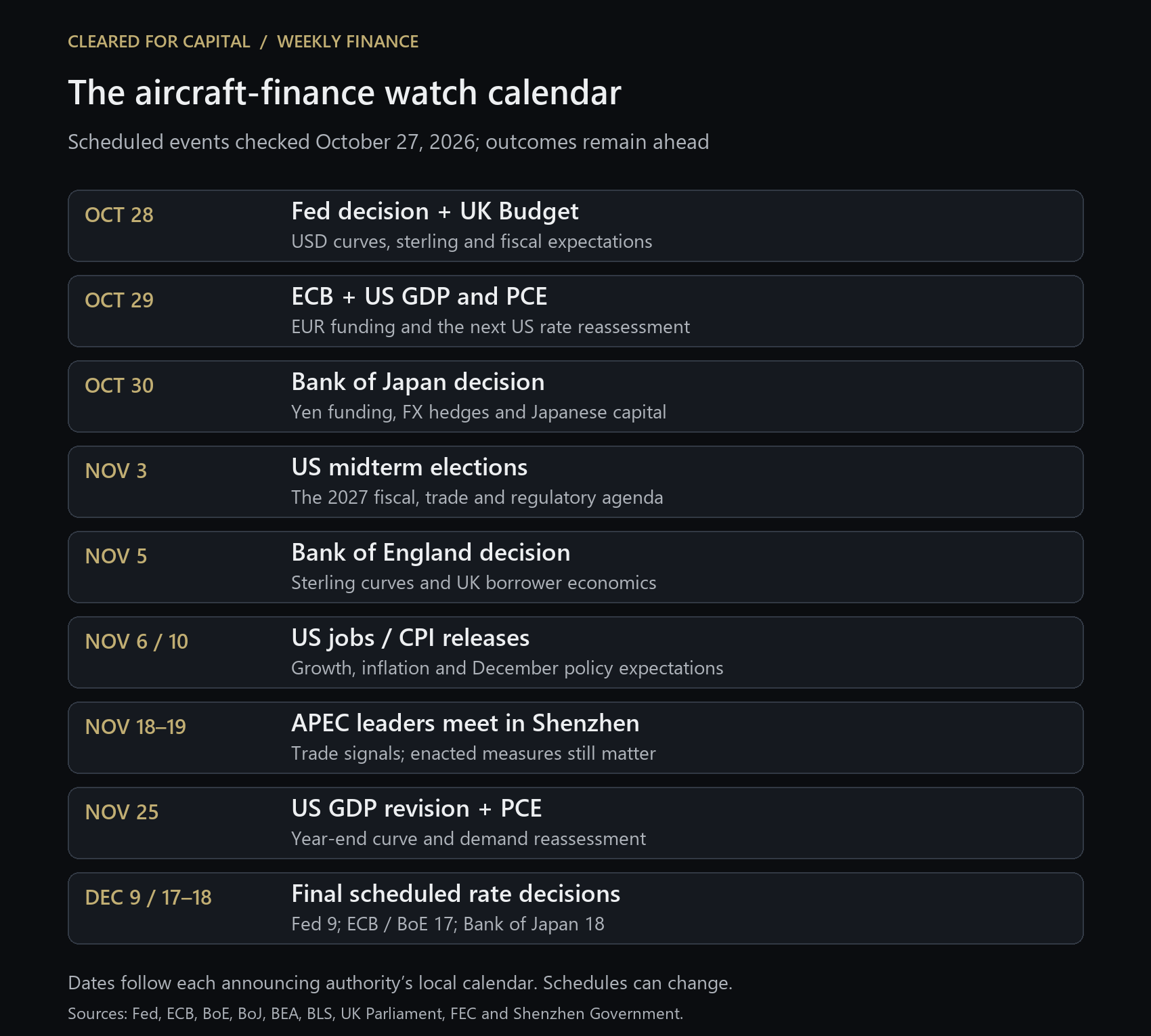
    2026 watch calendar: October 28 Fed and UK Budget; October 29 ECB, US GDP and PCE; October 30 Bank of Japan; November 3 US election; November 5 Bank of England; November 6 jobs and November 10 CPI; November 18–19 APEC; November 25 GDP and PCE; December 9 Fed, December 17 ECB and Bank of England, and December 18 Bank of Japan. Each event may affect funding, currencies, credit or trade.
    Scheduled events through year-end 2026, checked October 27. Official calendars and primary sources are linked in the accompanying text. Impacts shown are analytical channels, not predicted outcomes.

    Next come the US congressional general election on November 3, the Bank of England decision on November 5, and US employment and CPI releases on November 6 and 10. APEC’s Economic Leaders’ Meeting is scheduled for November 18–19 in Shenzhen. BEA lists the next GDP estimate and October income-and-outlays release for November 25.

    The final scheduled policy round clusters around year-end funding decisions: the Fed on December 8–9, the ECB and Bank of England decisions on December 17, and the Bank of Japan meeting on December 17–18. These are scheduled events, not assumed outcomes. Dates follow the relevant authority’s local calendar; release schedules can change.

    1. Rates: a lower headline rate is not the same as cheaper aircraft debt

    The starting point matters. The Fed raised its target range to 3.75%–4.00% in September. The ECB deposit-facility rate is 2.50%, while the Bank of England’s published current Bank Rate is 3.75%. These policy rates are not directly comparable quotes for an aircraft financing in dollars, euros or sterling.

    Banka Slovenije’s October review, using data available by October 20, described market pricing for a further quarter-point increase by both the Fed and ECB before year-end. That is a dated snapshot, not live meeting odds. Its emphasis on persistent energy-related inflation explains why assuming imminent, broad financing relief would be premature.

    Likely effect: policy surprises should feed into benchmark curves, swaps and currencies first. Floating-rate facilities depend on their contractual reset benchmark and any floors; fixed-rate notes and loans depend on the relevant term curve and spread at pricing or hedging. A cut in an overnight policy rate need not produce an equal fall in five-year aircraft debt costs, and existing fixed-rate debt does not automatically reprice.
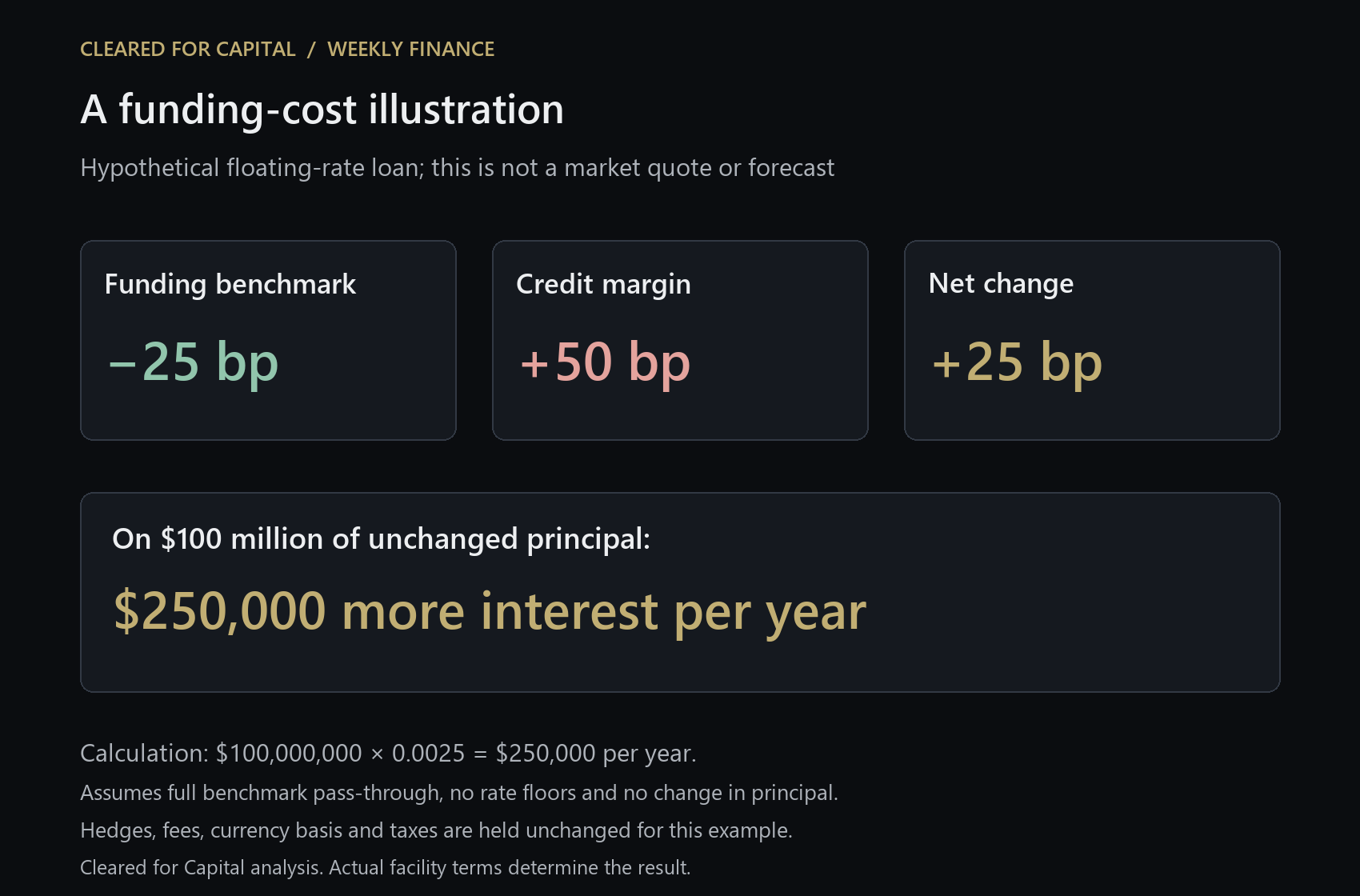
    Hypothetical funding example: a 25-basis-point benchmark decline plus a 50-basis-point credit-margin increase raises the total interest rate by 25 basis points. On unchanged principal of 100 million dollars, that adds 250,000 dollars in annual interest, holding hedges, fees, currency basis and taxes constant, with no floor and full benchmark pass-through.
    Cleared for Capital illustration: a lower benchmark can be outweighed by a wider credit margin. This is not a current financing quote or forecast.

    The example holds hedges, fees, currency basis, taxes and principal constant. In a real deal, those items can alter the outcome. The useful comparison is an all-in financing proposal for the same asset, currency, tenor, amortization and risk allocation—not two central-bank policy rates.

    For Japanese and European capital providers, the comparison also includes hedging into the lease currency. The Bank of Japan decision can affect yen funding and investor returns without mechanically moving dollar lease costs in the same direction. Cross-currency basis—the difference between direct currency funding and funding through a currency swap—can change that comparison. The BIS definition explains the distinction; its 2026 foreign-currency funding report also highlights the rollover risk that hedges can introduce.

    2. Economic releases: growth and inflation can pull credit in different directions

    The October 29 GDP and PCE reports, November 6 jobs report and November 10 CPI report will help shape the next round of rate expectations. They also speak to passenger demand, corporate travel budgets, cargo activity and airline margins. A strong growth print can support traffic while sustaining higher interest rates. Softer inflation can help funding conditions; weaker demand can simultaneously make lenders more cautious.

    Our interpretation: the friendliest combination for aircraft finance is easing inflation with resilient cash flows. A slowdown that cuts policy rates but weakens lessee credit may widen margins, reduce advance rates or strengthen reserve requirements. That distinction matters for aircraft ABS, bank loans and private credit alike. Our AASET/WAVE analysis explains how benchmark-rate changes and credit deterioration reach lease-backed bonds through different channels.

    Currency exposure adds another layer outside the dollar area. If the local-currency cost of a dollar rises 10%, an unchanged dollar lease payment costs 10% more in local currency before hedges, assuming local revenue is unchanged. The vulnerability is the currency mismatch—not an operator’s nationality alone. Airlines and business-jet operators earning mostly local currency need different stress cases from borrowers with matching dollar income.

    3. Financing and deliveries: watch the results, then the cash commitments

    AerCap will report third-quarter results on October 28, with its call scheduled for 8:30 a.m. Eastern. Airbus also schedules its nine-month results for October 28. For financiers, the useful signals will be lease economics, customer performance, asset-sale outcomes, funding costs, production guidance and delivery timing. The announcements themselves are forthcoming; this article does not assume their results.

    Delivery delays can extend pre-delivery-payment borrowing, leave takeout debt undrawn and create additional carry or commitment costs, depending on the contracts. Scarcity may support rentals for aircraft already available, while the owner of an undelivered aircraft still waits for rent to begin. A higher appraised value does not eliminate that timing gap.

    For the year-end funding window, the practical issue is whether a commitment, hedge and draw period still match the likely delivery or refinancing date. Banks, leasing companies, ABS investors and private-credit providers do not all have the same capacity or pricing constraints. We expect execution certainty and the terms of committed funding to remain important, particularly around the December decision cluster.

    Two disclosed milestones also bear watching: Southwest expects its notes to settle on November 2, while JetBlue expects additional aircraft-backed funding in the fourth quarter. They are issuer-specific tests of execution, not proof that financing is equally available worldwide. Their announced status and source documents appear in our weekly deals briefing.

    4. Politics: the UK Budget, US election and APEC have different channels

    UK Budget, October 28: the main financing channels are fiscal expectations, gilt yields, sterling and any actual tax measures affecting aviation demand, aircraft ownership or leasing. Watch the published measures and effective dates before changing a transaction model. A fiscal announcement can move funding markets before a tax change affects operating cash flows.

    US election, November 3: the outcome can change expectations for the 2027 fiscal, trade and regulatory agenda. Its effect on aircraft finance depends on subsequent measures and the market response, rather than the election date alone. An existing lease, import treatment or financing contract does not change simply because an electoral result is announced.

    APEC, November 18–19: the summit offers a near-term venue for Asia-Pacific trade and investment signals. Concrete progress on trade frictions could improve confidence in deliveries and cross-border capital allocation; deterioration could increase uncertainty around parts, aircraft movements and payments. We are not assuming a particular bilateral meeting, aircraft order or tariff agreement will occur.

    For transactions involving US imports, the USITC’s current Harmonized Tariff Schedule resources are a starting point for checking the actual product treatment. Aircraft, engines and individual parts can have different classifications and conditions. Broad tariff headlines are not enough to calculate the landed cost of a specific aircraft or lease arrangement.

    5. Geopolitics, fuel and carbon: operating costs become credit risks

    The Middle East energy and inflation risks discussed in the October central-bank review remain relevant to underwriting. De-escalation could ease fuel, insurance and route-disruption costs; renewed escalation could reverse that relief. The effect on rent-paying ability depends on the airline’s hedges, pricing power, network and liquidity. Lower oil prices alone would not resolve an existing balance-sheet problem.

    Sanctions and export restrictions have a different channel: they may affect whether a delivery, payment, maintenance arrangement or repossession can proceed. The European Commission’s current Russia-sanctions materials illustrate why this remains an ongoing cross-border issue. Better credit pricing cannot substitute for an executable transaction and workable asset-recovery route; the relevant rules and counterparties must be assessed at execution.

    Year-end also leads into CORSIA’s second phase, beginning in 2027, with participation criteria and exemptions. It operates through multiyear compliance periods, so this is not a universal offset-payment bill due on January 1. In Europe, general free aviation ETS allocation has already been phased out in 2026, alongside separate support for eligible sustainable fuels. These are distinct regimes; route coverage and operator treatment matter. Carbon and fuel assumptions belong in 2027 operating budgets and credit models, without treating every business-aircraft operation as identically covered.

    The outlook for international borrowers and investors

    Base case: financing stays available on differentiated terms, and benchmark costs, hedge economics and execution risk remain central. Better credits and marketable assets should retain more alternatives; we do not expect every borrower to benefit equally from a change in policy rates.

    Upside case: softer inflation, resilient demand and easing trade or energy tensions could lower funding pressure while supporting collections and delivery confidence. Downside case: renewed inflation or geopolitical disruption could keep rates elevated while weakening airline cash flow, making debt both more expensive and harder to execute. These are conditional scenarios without assigned probabilities or bond-price targets.

    For business aviation, the same channels reach the borrower through interest expense, currency mismatches, import costs and the timing of delivery and refinancing. For international lessors and aircraft-ABS investors, they also reach portfolio collections, maintenance reserves, remarketing costs and residual proceeds. The decisive question is how a transaction performs under a combined rate, currency and operating-cost shock—not whether a single policy headline sounds favourable.

    Sources and method: official central-bank calendars and statements, BEA and BLS schedules, UK Parliament, FEC, Shenzhen Government, ICAO, EASA, USITC, European Commission and the companies cited above. Information checked as of October 27, 2026 in New York; no October 28 or later event outcomes are assumed. Dated facts are distinguished from Cleared for Capital’s analysis. The funding-cost illustration is hypothetical, and this article is informational rather than a recommendation to transact.
  • Aircraft ABS: AASET 2026-1, WAVE 2019-1 and the Risks Behind the Bonds

    Aircraft ABS: AASET 2026-1, WAVE 2019-1 and the Risks Behind the Bonds

    Credit analysis | Reviewed October 27, 2026 | Treasury comparison through October 26

    Aircraft lease asset-backed securities turn rent and aircraft-sale proceeds into payments for bondholders. Comparing AASET 2026-1 with WAVE 2019-1 shows why a bond’s coupon, collateral, payment history and place in the cash-flow waterfall all matter. A higher Treasury yield can reduce a fixed-rate bond’s value even when its contractual payments are unchanged; weaker lease collections create a separate credit problem.

    The distinction is central to this updated analysis. We can verify important issuance terms and dated rating actions. We have not verified executable October 26 secondary-market quotes for either transaction, so the pricing discussion below uses an explicit sensitivity illustration rather than presenting model ranges as current trading levels.

    At issuance: funding size needs a careful reading

    The Cayman Islands Stock Exchange listings identify $436.983 million of AASET A-1 notes, $52.438 million of B-1 notes, up to $203.595 million of delayed-draw A-2 notes and up to $24.431 million of delayed-draw B-2 notes. The arithmetic is $489.421 million of non-delayed notes plus $228.026 million of delayed capacity: $717.447 million in total. That total is not evidence that the whole amount was funded at closing. The separately listed $261.412 million of E certificates is not part of the note total.

    Morningstar DBRS’s original analysis says the delayed-draw classes were initially unfunded and would finance up to four A321neos after delivery. Its July 30 final-rating release assigned A (high) (sf) to both A-1 and A-2. These are the ratings at that date; they should not be confused with a fresh surveillance opinion or with the credit rating of the sponsor.

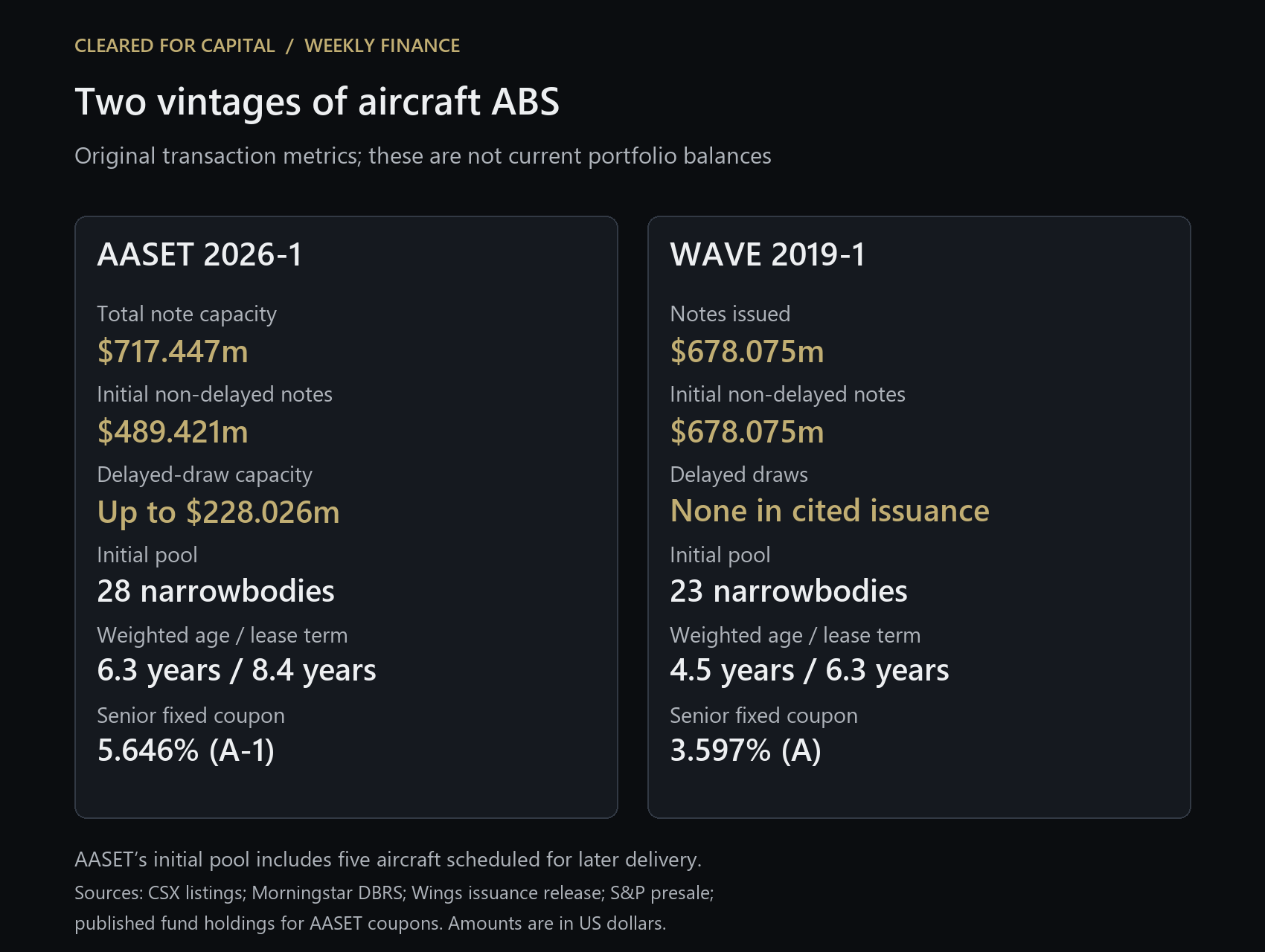
    At issuance: AASET note capacity $717.447m, including $489.421m non-delayed notes and up to $228.026m delayed draws; initial pool 28 narrowbodies, weighted age 6.3 years and lease term 8.4 years, senior coupon 5.646%. WAVE issued $678.075m notes; initial pool 23 narrowbodies, age 4.5 years and lease term 6.3 years, senior coupon 3.597%. Initial values are not current balances.
    Original issuance metrics. Sources: CSX, Morningstar DBRS, Wings and S&P. AASET coupon cross-checks are linked below.
    Transaction / classOriginal amountFixed coupon
    AASET A-1$436.983m5.646%
    AASET B-1$52.438m6.572%
    AASET A-2 / B-2Up to $203.595m / $24.431mDelayed-draw classes; no coupon assumed here
    WAVE A$555.531m3.597%
    WAVE B$81.696m4.581%
    WAVE C$40.848m6.413%

    Wings’ October 1, 2019 issuance announcement gives WAVE’s $678.075 million total and the three final coupons above. AASET coupons are cross-checked against published holdings, including BNY’s July 31 fund schedule and a July 31 Global Opportunities Portfolio filing. Presale coupon assumptions are not final coupons, and a coupon is not a secondary-market yield. All amounts here are original issue amounts or commitments, not current outstanding balances.

    Collateral and cash-flow protection

    At issuance, DBRS described AASET’s pool as 28 narrowbody aircraft, including five awaiting manufacture and future delivery. Its presale reported a 6.3-year weighted age and 8.4-year remaining lease term. The final analysis cited 75% Series A loan-to-value, a liquidity facility sized to nine months of Series A interest, and an initially funded $50 million maintenance reserve. It also described performance triggers and an expected final payment date seven years after closing. The legal final maturity and the expected repayment date serve different purposes.

    For WAVE, the September 2019 S&P presale described 23 aircraft, 17 airline lessees, a 4.5-year weighted age and a 6.3-year remaining lease term. It identified substantial emerging-market lessee exposure. These are starting characteristics, not a description of the fleet or its remaining leases today.

    Our interpretation: Longer contracted leases can improve visibility, but rent still depends on airline payment capacity. A maintenance reserve can absorb designated expenses without guaranteeing full recovery. A liquidity line addresses timing shortfalls within its terms; it cannot indefinitely replace missing rent. The relevant test is whether collections and net sale proceeds meet the transaction’s actual obligations after expenses, reserve requirements and payment priorities.

    WAVE’s rating history: the CreditWatch review was resolved

    The historical record should not stop at February 2023. In its May 2023 review, S&P affirmed WAVE A at BBB+ (sf) and B at BB+ (sf), lowered C to CCC+ (sf), and removed the ratings from CreditWatch negative. It cited scheduled-principal shortfalls and insufficient protection for the junior class. Those are dated historical ratings, not a claim about each class’s current rating.

    KBRA’s January 9, 2026 surveillance announcement includes WAVE among transactions serviced by Castlelake or its affiliate. Its public summary discusses affirmations and upgrades across the group, without identifying every class action in the summary itself. A current investment decision needs the class-specific agency record and current trustee data; the earlier watch status should not be carried forward as though it remains unresolved.

    The S&P review also identifies WAVE’s 144A class A CUSIP as 94354KAA8, B as 94354KAB6 and C as 94354KAC4. A valid identifier check digit is useful, but only a security record or transaction document establishes the class mapping.

    Rates versus credit: what the price model can show

    The US Treasury’s daily par-yield data show the five-year yield at 4.26% on July 15 and 4.84% on October 26: a rise of 58 basis points. The ten-year moved from 4.55% to 5.00%, or 45 basis points. These observations retain the original article’s October 26 comparison date and correct its benchmark endpoints.

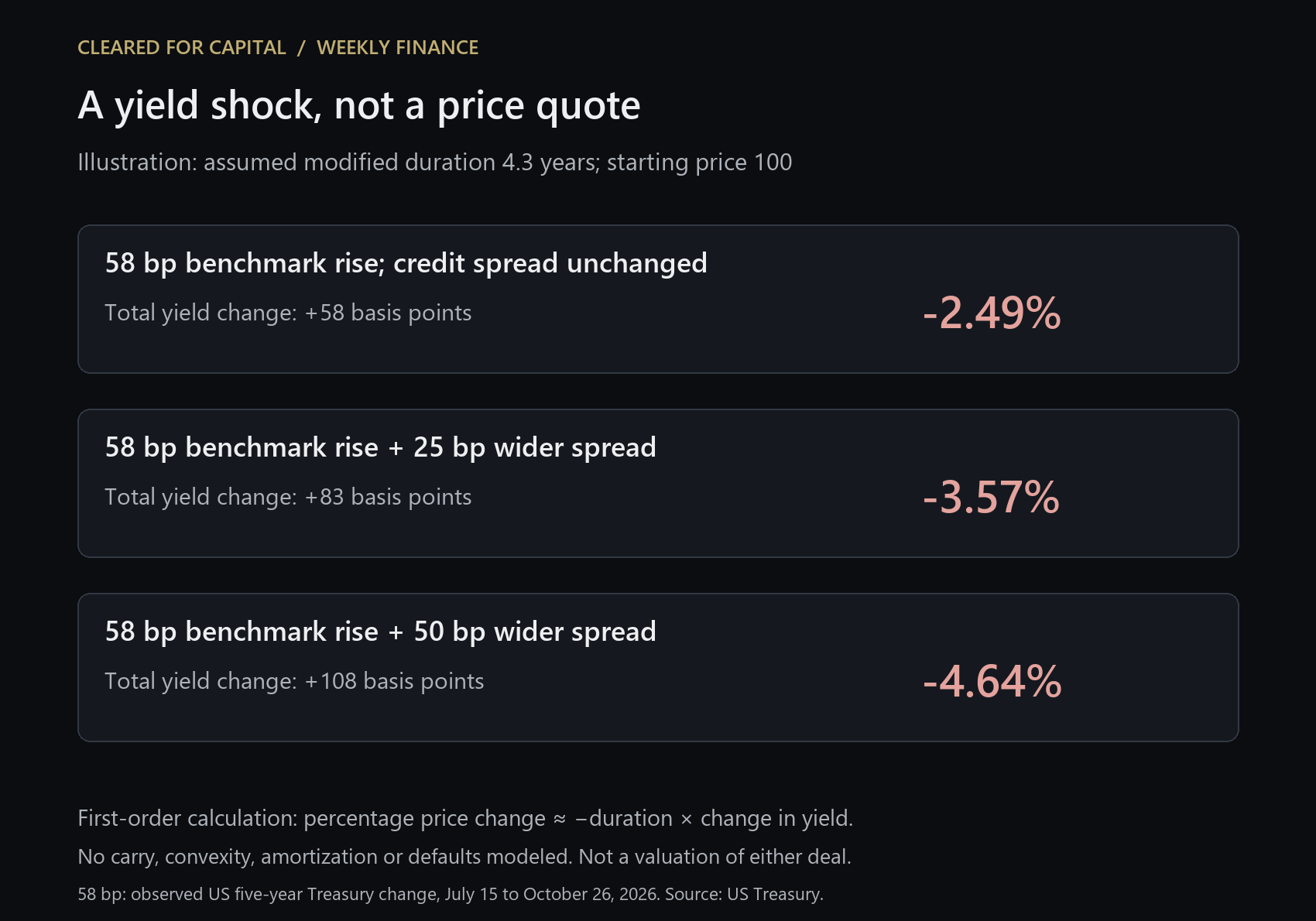
    For an illustrative bond with an assumed modified duration of 4.3 years, the first-order calculation is percentage price change ≈ −modified duration × yield change. A 58-basis-point rise in the bond’s required yield would imply about a 2.49% decline, or 2.49 points from a starting price of 100. That duration is a scenario assumption, not a measured duration for either AASET or WAVE. A five-year Treasury move is also only a benchmark proxy, not the full term structure used to value amortizing ABS.

    Illustration using assumed modified duration 4.3 years: 58 basis points higher required yield implies a 2.49% price decline; adding 25 basis points of spread widening implies minus 3.57%; adding 50 implies minus 4.64%. Starting price 100. This excludes carry, convexity, amortization and defaults and is not a valuation of either transaction.
    Illustrative model, not observed ABS prices. The US Treasury benchmark moved 58 basis points between July 15 and October 26; duration and spread shocks are explicit assumptions.

    The illustration excludes coupon carry, principal distributions, convexity, defaults and changes in cash-flow timing. Spread widening would add another source of price pressure; falling rates could offset some credit-related widening. A true then-versus-now comparison requires dated clean prices, accrued interest, current principal factors and intervening cash distributions. Comparing an original face amount with today’s amortized position will not produce a valid total return.

    What we can and cannot call a market price

    Rule 144A status alone does not prove that trade information is unavailable. FINRA’s SPDS-144A documentation describes dissemination of transactions in certain eligible asset-backed securities. Coverage, access and trade frequency still need checking for the specific instrument. We did not verify a dated secondary trade or executable quote for these classes during this review. That is a limit of this evidence, not a statement that no reported trades exist.

    For the same reason, this version does not present the earlier AASET and WAVE model price bands as observed October 26 prices, assign probabilities to oil-and-credit scenarios, or describe an unverified discount as a buying opportunity. To value WAVE’s low-coupon amortizing notes, the remaining principal schedule and actual waterfall matter at least as much as a generic assumed weighted-average life.

    Airline stress is the transmission mechanism

    Fuel, fares and traffic matter because they affect lessees’ ability to pay rent. Stress can then reach ABS through delayed collections, lease restructuring, repossession costs, downtime, re-leasing economics and aircraft sale values. A junior class generally has less protection from deterioration in available cash than a senior class, subject to the particular transaction’s terms.

    Recent operating disclosures show why airline and lessor conditions need separate examination. JetBlue’s October 26 results reported $2.2 billion of liquidity, including a $600 million undrawn facility, with another $250 million of aircraft-backed funding expected in the fourth quarter. AerCap’s third-quarter activity update reported 85 lease agreements and 34 asset purchases; those totals include engines or helicopters as well as aircraft. Active transactions do not by themselves establish lease profitability or immunity from airline defaults.

    These companies illustrate sector conditions. This article does not identify them as lessees of either ABS pool without supporting portfolio disclosure. Airline share prices are also not prices for lease-backed notes. For dated equity context, see our weekly aircraft-finance roundup.

    The Cleared for Capital view

    The comparison remains useful when each vintage is judged on its current cash flows. For AASET, follow aircraft deliveries and delayed funding, collections, maintenance spending and trigger headroom. For WAVE, focus on the latest principal factor, unpaid scheduled amounts, lease expirations, aircraft dispositions and class-specific surveillance. Rates can move prices before credit changes, while weak collections can change both expected timing and ultimate recovery.

    For business-aircraft owners and financiers, the transferable lesson is to separate funding cost, borrower credit and asset recovery. These commercial-aircraft securitizations do not establish the loan margin, advance rate or residual value available on a private jet. Any comparison needs the relevant asset, jurisdiction, maintenance condition and financing contract.

    Source note: adapted and updated from the author’s October 26 feature at The Closing Print. Reviewed October 27, 2026. Issuance facts, historical rating actions and model assumptions are labelled separately. Current trustee balances, class-specific current ratings and executable secondary quotes were not independently confirmed. Analysis is informational and is not a recommendation to transact.

  • Aircraft Finance This Week: Closed Deals, New Funding and Stock Moves

    Weekly briefing | October 21–27, 2026

    Completed aircraft transactions, expected borrowing and bond pricing featured in the October 21–27 announcements. This briefing separates reported completions from funding still ahead, then examines share-price moves for listed airlines around the news.

    DAE reported completion of its ten-aircraft United Airlines mandate, ABL acquired a leased A320neo, and JetBlue flagged expected fourth-quarter financing. Related capital raises cover the aviation aftermarket and Southwest’s corporate refinancing.

    The aircraft deals at a glance

    AnnouncementTransactionSizeStatus
    October 21DAE / United Airlines10 Boeing 737-9 aircraft; value undisclosedFinal delivery under an agreement signed earlier in 2026
    October 21ABL Aviation / Transavia France1 Airbus A320neo; value undisclosedSecondary-market acquisition completed; existing lease continues
    October 26JetBlue$250 millionAircraft-backed financing expected to fund in Q4, subject to funding mechanics

    Closed this week: completed deals reported October 21–27

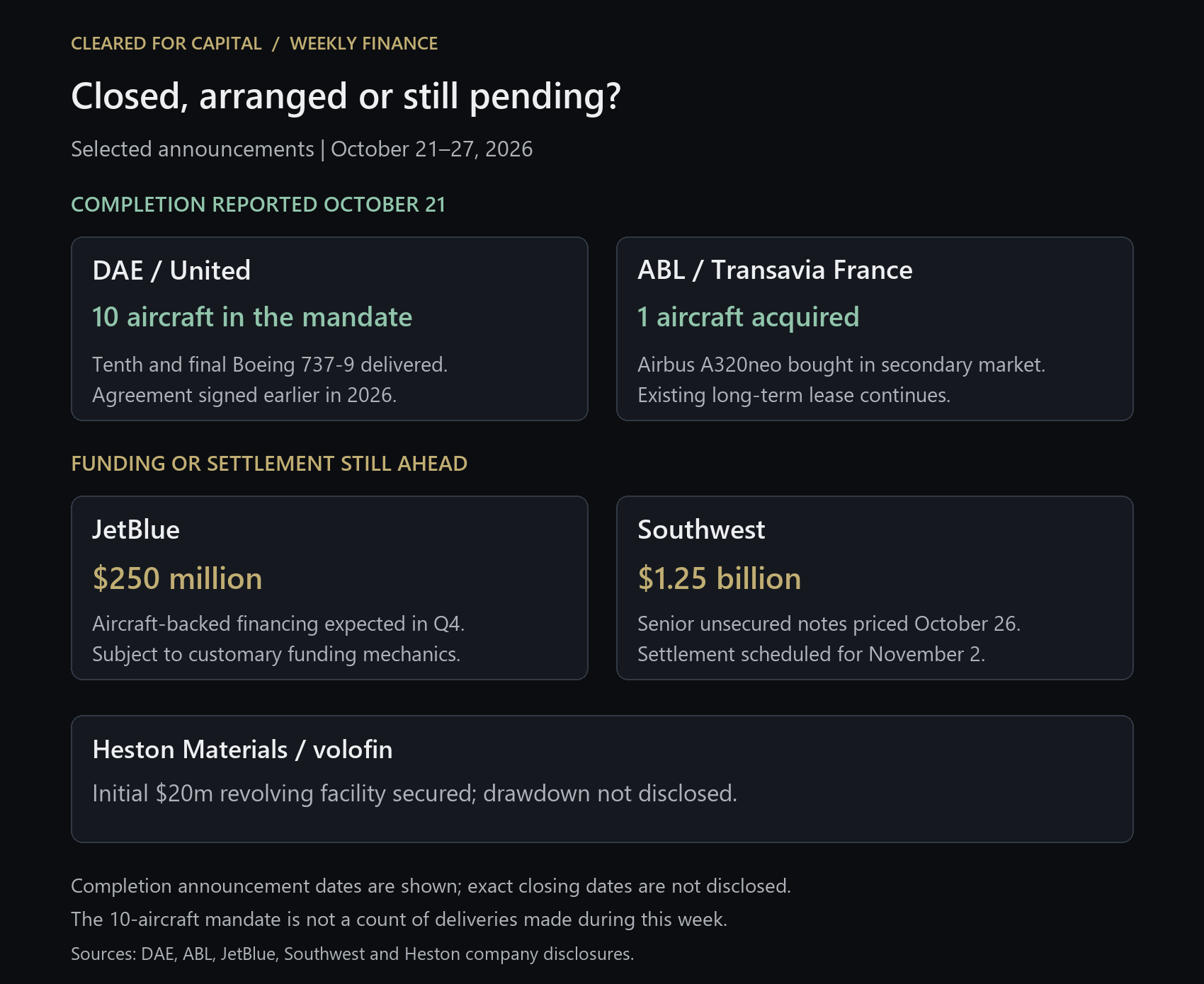
    Both transactions below were reported as completed in company announcements dated October 21. The releases do not give separate legal closing dates. “Closed this week” therefore identifies completion reports published during the week; it does not establish that every aircraft transfer occurred within these seven days.

    Completion reports dated October 21: DAE delivered the final aircraft of a ten-plane United mandate; ABL acquired one leased A320neo. Exact closing dates are not disclosed. JetBlue expects $250m funding in Q4; Southwest priced $1.25bn notes for November 2 settlement; Heston secured an initial $20m revolving facility with drawdown undisclosed.
    Deal status as of October 27. Sources: DAE, ABL, JetBlue, Southwest and Heston.

    DAE completes its ten-aircraft United sale-and-leaseback

    DAE announced on October 21 that it had delivered the tenth and final Boeing 737-9 to United under a sale-and-leaseback agreement signed earlier in 2026.

    The mandate was completed in three months from document execution. DAE said the transaction was executed with Equator and Mustang, with DAE Capital acting as servicer. Its overall fleet on lease to United reached 26 aircraft.

    This is a newly announced completion milestone, rather than a ten-aircraft agreement first signed during the reporting week. DAE did not disclose the transaction value or lease pricing.

    ABL buys an A320neo with the Transavia France lease attached

    ABL Aviation’s October 21 announcement confirmed the acquisition of an Airbus A320neo powered by CFM LEAP-1A24 engines through a secondary-market transaction.

    The existing long-term lease to Transavia France remains in place. The announcement describes an aircraft investment transaction; it does not disclose the purchase price, seller or acquisition debt terms. It should not be read as a newly originated lease or a newly delivered aircraft.

    JetBlue flags $250 million in aircraft-backed financing

    In its October 26 earnings announcement, JetBlue said an additional $250 million of aircraft-backed financing was expected to fund in the fourth quarter, subject to customary funding mechanics.

    The airline reported $2.2 billion of quarter-end liquidity, including an undrawn $600 million credit facility. It also put its unencumbered asset base at approximately $7 billion, including $2.8 billion in aircraft and engines.

    The $250 million should therefore be tracked as expected funding, rather than cash already received. The disclosure does not specify the lender, interest rate, maturity or aircraft securing that amount.

    Related capital: aftermarket assets and airline refinancing

    Heston Materials secures an initial $20 million facility

    On October 26, Heston Materials announced initial financing of $20 million from volofin Capital Management for aviation asset acquisitions and business expansion. A company-issued statement carried by ELTA describes flexible funding to support acquisition opportunities.

    The English-language announcement carried by AVIATOR identifies a revolving facility. It gives no maturity, interest rate or collateral terms. This is aviation aftermarket financing, with no specific aircraft purchase identified. The disclosure does not establish whether any of the facility had been drawn by the reporting cutoff.

    Southwest prices $1.25 billion of senior unsecured notes

    Southwest’s October 26 pricing term sheet sets out $600 million of 5.750% notes due in 2029 and $650 million of 6.000% notes due in 2031. Settlement is scheduled for November 2.

    Its prospectus identifies the notes as general unsecured obligations. Proceeds are intended for general corporate purposes, potentially including repayment of $300 million of notes maturing in November. This is broader airline financing, rather than a disclosed loan against particular aircraft.

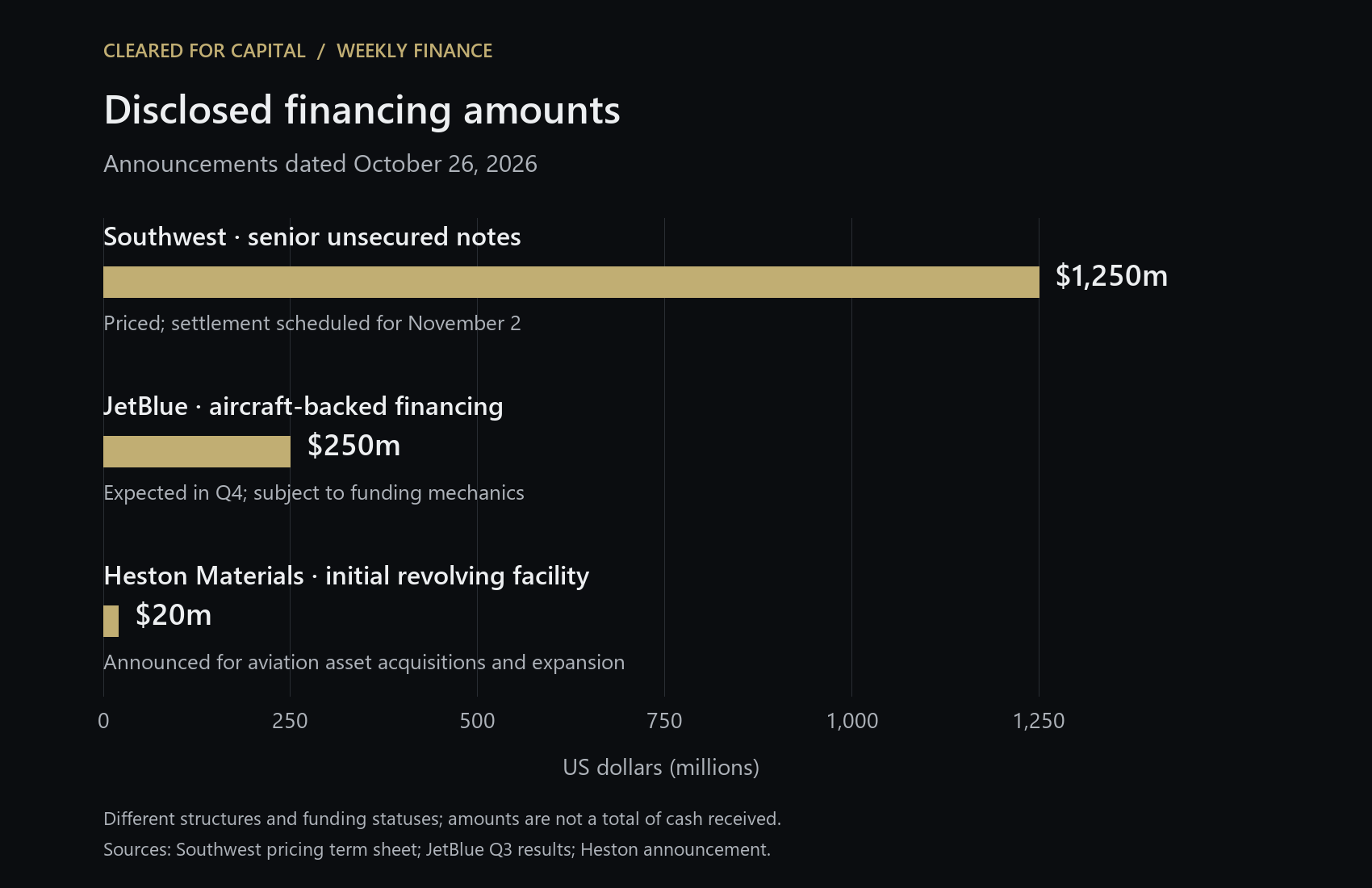
    Disclosed financing amounts: Southwest senior unsecured notes $1,250 million, priced for November 2 settlement; JetBlue aircraft-backed financing $250 million, expected in Q4; Heston Materials initial revolving facility $20 million. Structures and funding statuses differ.
    Amounts are in US dollars and represent different structures and funding stages. Sources: Southwest pricing term sheet, JetBlue Q3 results and Heston announcement, October 26, 2026.

    Stock-market context: what moved around the announcements

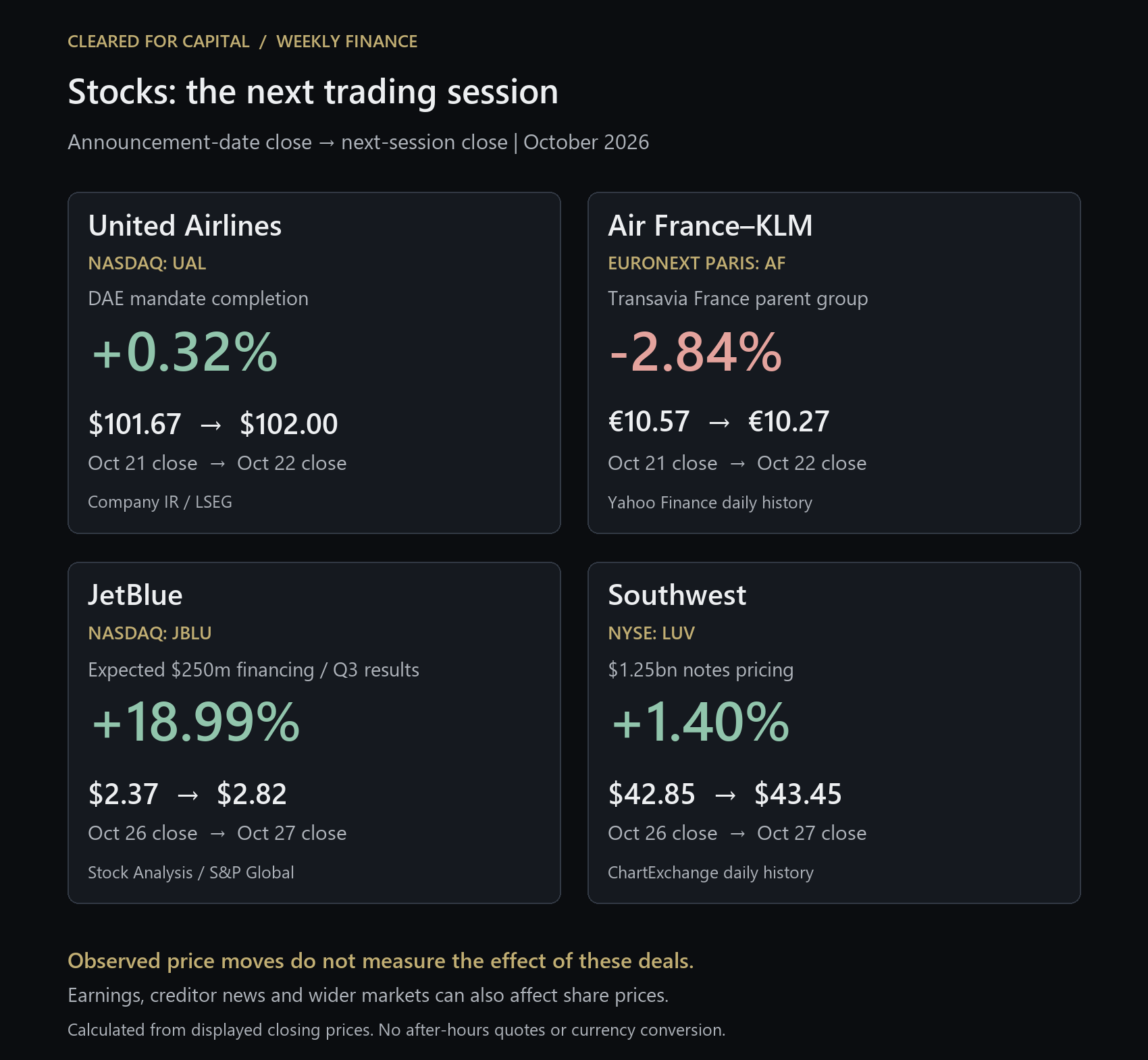
    The listed airline exposures covered here are United Airlines Holdings (NASDAQ: UAL), JetBlue (NASDAQ: JBLU), Southwest (NYSE: LUV), and Air France–KLM (Euronext Paris: AF), the parent group of Transavia France. The infographic compares each announcement date’s regular-session close with the next trading session’s close.

    Announcement-date close to next-session close, October 2026: United $101.67 to $102.00 on October 21 to 22, plus 0.32%; Air France-KLM EUR10.57 to EUR10.27 on October 21 to 22, minus 2.84%; JetBlue $2.37 to $2.82 on October 26 to 27, plus 18.99%; Southwest $42.85 to $43.45 on October 26 to 27, plus 1.40%. These observed changes do not measure deal-specific effects.
    Next-session price moves calculated from displayed daily closes. Sources: United IR / LSEG, Yahoo Finance, Stock Analysis / S&P Global and ChartExchange.

    United / DAE: United closed at $97.77 on October 20 and $101.67 on October 21, a calculated 3.99% increase on the completion-announcement date. It closed at $102.00 on October 22, another 0.32%. These company-published closing prices show an observed rise, but do not isolate the contribution of the sale-and-leaseback. The completion release gives no transaction value or quantified earnings effect.

    Air France–KLM / ABL: The Paris-listed parent group closed at €10.47 on October 20, €10.57 on October 21 (+0.96%), and €10.27 on October 22 (−2.84%), using daily historical closes. This tracks the airline’s parent, not ABL’s investment performance. The acquired aircraft’s existing lease continued; the announcement and these prices do not establish a deal-specific share-price effect.

    JetBlue: JBLU rose from $2.37 at the October 26 close to $2.82 at the October 27 close, a calculated 18.99%, according to Stock Analysis’s historical prices. The expected $250 million financing was one item in the broader earnings release. Reuters linked the rally to the revenue outlook and management’s defence of the airline’s financial position, amid creditor-related concerns. That reporting supports a broader earnings-and-liquidity reaction; it does not quantify the financing item’s individual effect.

    Southwest: LUV closed at $42.85 on October 26 and $43.45 on October 27, a calculated 1.40% increase, using ChartExchange’s daily closes. The company’s pricing release was published at 5:08 p.m. EDT on October 26, after the regular market close. The earlier October 26 gain of 2.63%, from the October 23 close of $41.75, preceded that release and should not be described as its reaction. The following session’s gain alone does not establish a bond-pricing effect.

    Method and attribution: Percentage changes are calculated from the displayed closing prices, rounded to two decimals, in each listing’s local currency. The infographic uses announcement-date close to next-session close consistently; same-day comparisons are identified in the text. These are price changes, excluding dividends and after-hours trading. Earnings, company news and wider market moves also matter. No deal-specific causal effect has been established from the sources reviewed.

    What this means for business aviation

    Our reading is that these announcements illustrate several uses of aviation capital: raising liquidity against assets, completing fleet ownership transactions and funding assets already earning lease income. That is useful context for business-aircraft owners and investors, even though the assets and counterparties differ.

    They do not establish private-jet loan rates, advance rates or residual-value assumptions. The commercial-aircraft transactions reported here provide no basis for inferring the terms a business-jet borrower could obtain.

    The next milestones are whether JetBlue receives the expected funding in Q4 and whether Southwest settles its notes on November 2. For the completed DAE and ABL transactions, pricing and financing details remain undisclosed.

    Scope: selected public announcements dated October 21–27, 2026, reviewed as of October 27 in New York. This is a report on disclosed transactions, not an exhaustive record of private financings. Analysis is identified separately from announced terms.