
Credit analysis | Reviewed October 27, 2026 | Treasury comparison through October 26
Aircraft lease asset-backed securities turn rent and aircraft-sale proceeds into payments for bondholders. Comparing AASET 2026-1 with WAVE 2019-1 shows why a bond’s coupon, collateral, payment history and place in the cash-flow waterfall all matter. A higher Treasury yield can reduce a fixed-rate bond’s value even when its contractual payments are unchanged; weaker lease collections create a separate credit problem.
The distinction is central to this updated analysis. We can verify important issuance terms and dated rating actions. We have not verified executable October 26 secondary-market quotes for either transaction, so the pricing discussion below uses an explicit sensitivity illustration rather than presenting model ranges as current trading levels.
At issuance: funding size needs a careful reading
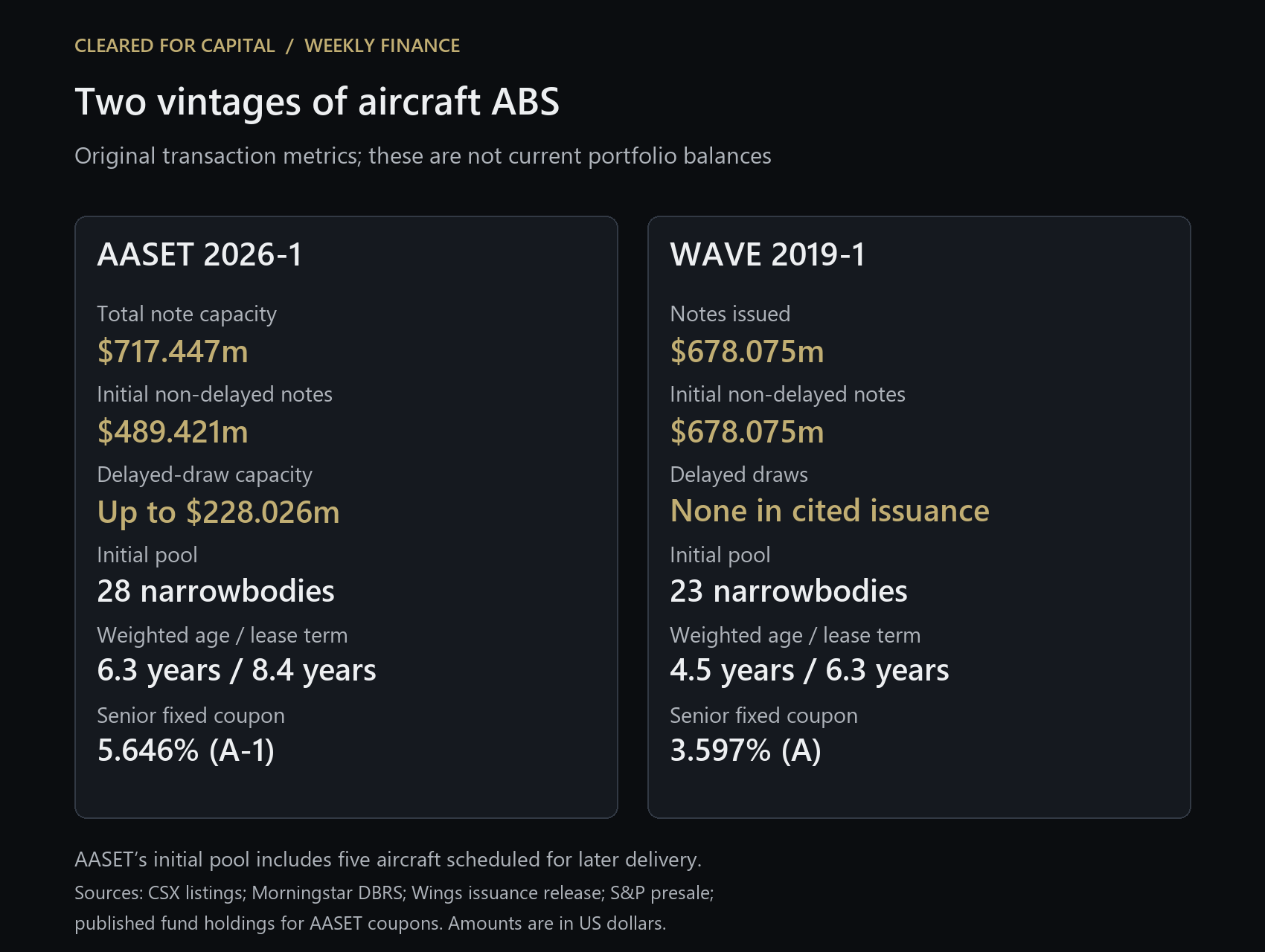
The Cayman Islands Stock Exchange listings identify $436.983 million of AASET A-1 notes, $52.438 million of B-1 notes, up to $203.595 million of delayed-draw A-2 notes and up to $24.431 million of delayed-draw B-2 notes. The arithmetic is $489.421 million of non-delayed notes plus $228.026 million of delayed capacity: $717.447 million in total. That total is not evidence that the whole amount was funded at closing. The separately listed $261.412 million of E certificates is not part of the note total.
Morningstar DBRS’s original analysis says the delayed-draw classes were initially unfunded and would finance up to four A321neos after delivery. Its July 30 final-rating release assigned A (high) (sf) to both A-1 and A-2. These are the ratings at that date; they should not be confused with a fresh surveillance opinion or with the credit rating of the sponsor.
| Transaction / class | Original amount | Fixed coupon |
|---|---|---|
| AASET A-1 | $436.983m | 5.646% |
| AASET B-1 | $52.438m | 6.572% |
| AASET A-2 / B-2 | Up to $203.595m / $24.431m | Delayed-draw classes; no coupon assumed here |
| WAVE A | $555.531m | 3.597% |
| WAVE B | $81.696m | 4.581% |
| WAVE C | $40.848m | 6.413% |
Wings’ October 1, 2019 issuance announcement gives WAVE’s $678.075 million total and the three final coupons above. AASET coupons are cross-checked against published holdings, including BNY’s July 31 fund schedule and a July 31 Global Opportunities Portfolio filing. Presale coupon assumptions are not final coupons, and a coupon is not a secondary-market yield. All amounts here are original issue amounts or commitments, not current outstanding balances.
Collateral and cash-flow protection
At issuance, DBRS described AASET’s pool as 28 narrowbody aircraft, including five awaiting manufacture and future delivery. Its presale reported a 6.3-year weighted age and 8.4-year remaining lease term. The final analysis cited 75% Series A loan-to-value, a liquidity facility sized to nine months of Series A interest, and an initially funded $50 million maintenance reserve. It also described performance triggers and an expected final payment date seven years after closing. The legal final maturity and the expected repayment date serve different purposes.
For WAVE, the September 2019 S&P presale described 23 aircraft, 17 airline lessees, a 4.5-year weighted age and a 6.3-year remaining lease term. It identified substantial emerging-market lessee exposure. These are starting characteristics, not a description of the fleet or its remaining leases today.
Our interpretation: Longer contracted leases can improve visibility, but rent still depends on airline payment capacity. A maintenance reserve can absorb designated expenses without guaranteeing full recovery. A liquidity line addresses timing shortfalls within its terms; it cannot indefinitely replace missing rent. The relevant test is whether collections and net sale proceeds meet the transaction’s actual obligations after expenses, reserve requirements and payment priorities.
WAVE’s rating history: the CreditWatch review was resolved
The historical record should not stop at February 2023. In its May 2023 review, S&P affirmed WAVE A at BBB+ (sf) and B at BB+ (sf), lowered C to CCC+ (sf), and removed the ratings from CreditWatch negative. It cited scheduled-principal shortfalls and insufficient protection for the junior class. Those are dated historical ratings, not a claim about each class’s current rating.
KBRA’s January 9, 2026 surveillance announcement includes WAVE among transactions serviced by Castlelake or its affiliate. Its public summary discusses affirmations and upgrades across the group, without identifying every class action in the summary itself. A current investment decision needs the class-specific agency record and current trustee data; the earlier watch status should not be carried forward as though it remains unresolved.
The S&P review also identifies WAVE’s 144A class A CUSIP as 94354KAA8, B as 94354KAB6 and C as 94354KAC4. A valid identifier check digit is useful, but only a security record or transaction document establishes the class mapping.
Rates versus credit: what the price model can show
The US Treasury’s daily par-yield data show the five-year yield at 4.26% on July 15 and 4.84% on October 26: a rise of 58 basis points. The ten-year moved from 4.55% to 5.00%, or 45 basis points. These observations retain the original article’s October 26 comparison date and correct its benchmark endpoints.
For an illustrative bond with an assumed modified duration of 4.3 years, the first-order calculation is percentage price change ≈ −modified duration × yield change. A 58-basis-point rise in the bond’s required yield would imply about a 2.49% decline, or 2.49 points from a starting price of 100. That duration is a scenario assumption, not a measured duration for either AASET or WAVE. A five-year Treasury move is also only a benchmark proxy, not the full term structure used to value amortizing ABS.
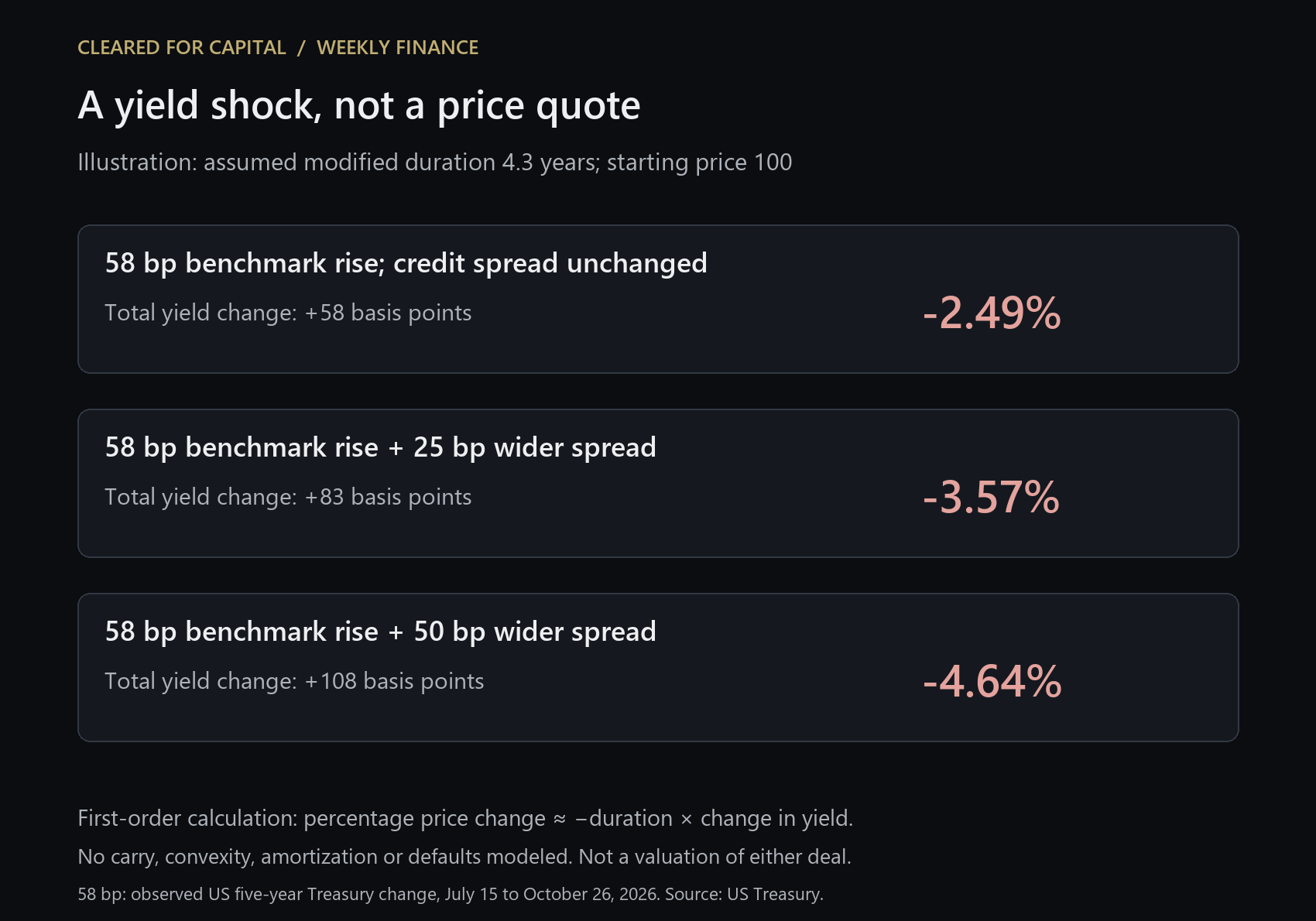
The illustration excludes coupon carry, principal distributions, convexity, defaults and changes in cash-flow timing. Spread widening would add another source of price pressure; falling rates could offset some credit-related widening. A true then-versus-now comparison requires dated clean prices, accrued interest, current principal factors and intervening cash distributions. Comparing an original face amount with today’s amortized position will not produce a valid total return.
What we can and cannot call a market price
Rule 144A status alone does not prove that trade information is unavailable. FINRA’s SPDS-144A documentation describes dissemination of transactions in certain eligible asset-backed securities. Coverage, access and trade frequency still need checking for the specific instrument. We did not verify a dated secondary trade or executable quote for these classes during this review. That is a limit of this evidence, not a statement that no reported trades exist.
For the same reason, this version does not present the earlier AASET and WAVE model price bands as observed October 26 prices, assign probabilities to oil-and-credit scenarios, or describe an unverified discount as a buying opportunity. To value WAVE’s low-coupon amortizing notes, the remaining principal schedule and actual waterfall matter at least as much as a generic assumed weighted-average life.
Airline stress is the transmission mechanism
Fuel, fares and traffic matter because they affect lessees’ ability to pay rent. Stress can then reach ABS through delayed collections, lease restructuring, repossession costs, downtime, re-leasing economics and aircraft sale values. A junior class generally has less protection from deterioration in available cash than a senior class, subject to the particular transaction’s terms.
Recent operating disclosures show why airline and lessor conditions need separate examination. JetBlue’s October 26 results reported $2.2 billion of liquidity, including a $600 million undrawn facility, with another $250 million of aircraft-backed funding expected in the fourth quarter. AerCap’s third-quarter activity update reported 85 lease agreements and 34 asset purchases; those totals include engines or helicopters as well as aircraft. Active transactions do not by themselves establish lease profitability or immunity from airline defaults.
These companies illustrate sector conditions. This article does not identify them as lessees of either ABS pool without supporting portfolio disclosure. Airline share prices are also not prices for lease-backed notes. For dated equity context, see our weekly aircraft-finance roundup.
The Cleared for Capital view
The comparison remains useful when each vintage is judged on its current cash flows. For AASET, follow aircraft deliveries and delayed funding, collections, maintenance spending and trigger headroom. For WAVE, focus on the latest principal factor, unpaid scheduled amounts, lease expirations, aircraft dispositions and class-specific surveillance. Rates can move prices before credit changes, while weak collections can change both expected timing and ultimate recovery.
For business-aircraft owners and financiers, the transferable lesson is to separate funding cost, borrower credit and asset recovery. These commercial-aircraft securitizations do not establish the loan margin, advance rate or residual value available on a private jet. Any comparison needs the relevant asset, jurisdiction, maintenance condition and financing contract.
Source note: adapted and updated from the author’s October 26 feature at The Closing Print. Reviewed October 27, 2026. Issuance facts, historical rating actions and model assumptions are labelled separately. Current trustee balances, class-specific current ratings and executable secondary quotes were not independently confirmed. Analysis is informational and is not a recommendation to transact.